
The Internet has changed significantly in recent years. While five to ten years ago it was primarily designed for people to visit websites to read information and use digital services, a fundamental shift is now emerging: An increasing portion of information retrieval and digital interactions now takes place with the help of artificial intelligence (AI). In this context, it is no longer exclusively humans who play the active role, but increasingly automated systems—so-called AI agents—that can independently process information and perform tasks.
Although automated search bots (e.g., Google’s search engine bots) have been part of the Internet for decades, their significance is changing significantly with the spread of artificial intelligence. Many websites are now seeing a decline in visitor numbers, particularly those with purely informational content. At the same time, the activity of AI crawler bots (the “search engine bots” of AI portals) that collect information is increasing more and more. More and more often, tasks that previously required people to visit various websites are now being handled directly by AI services. They research information, compare offers, answer questions, use digital services, or process orders and bookings. What used to require several separate visits to different websites can now increasingly be accomplished within a single interaction with an AI system. More and more often, AI services display relevant products and services directly within the search window alongside the corresponding response messages.
The Internet is thus undergoing a fundamental transformation. As people increasingly interact with the digital world through AI portals, information from numerous sources is aggregated and processed in the background. AI agents can access information and services directly through search engines, databases, or technical interfaces without a human user having to visit the original website. For users, this process is becoming increasingly invisible. They ask a question or formulate a request and receive the desired result, while the actual retrieval and processing of information takes place in the background.
This trend is likely to intensify in the coming years as the use of artificial intelligence becomes increasingly commonplace in everyday life. This development is by no means limited to major international providers such as OpenAI with ChatGPT, Anthropic with Claude, or Google with Gemini. Increasingly, companies, public institutions, organizations, and private individuals will also operate their own AI systems tailored to their specific needs. As a result, alongside the major public AI platforms, a growing number of internal AI systems are emerging that process information, tap into organizational knowledge, and handle digital tasks.
The reasons for this trend are obvious: data protection, data security, confidentiality, and control over one’s own information are—and will remain—key considerations for companies and organizations. Especially in Switzerland, where the responsible handling of data is a top priority, interest in independently operated AI solutions is likely to continue to grow. Those who operate AI within their own technical infrastructure can better control what data is processed, where it is stored, and who can access it. At the same time, this reduces dependence on individual international technology providers and prevents unnecessary data transfers to the EU or the U.S.—the data remains within the organization.
In addition, the technical and financial barriers to operating one’s own AI systems are steadily decreasing. What just a few years ago required powerful and expensive server infrastructures can now, in some cases, be implemented on off-the-shelf computers. In particular, the development of modern processors, specialized AI accelerators, and ever-increasing memory capacities is opening up new possibilities. Manufacturers such as Apple and Microsoft—or their hardware partners—have recently launched generations of devices that are increasingly designed for local AI processing. At the same time, AI models are becoming more efficient and can run with less computing power. Even more sophisticated language models can now be executed locally under the right conditions, although performance and the amount of information that can be processed simultaneously still depend heavily on the hardware used and the specific model.
Of particular interest here is the development of so-called open-source AI models and other freely available AI models. They enable companies and organizations to use artificial intelligence with increasing independence from the major commercial platforms. Such models can be run on their own servers, in secure data centers, or in some cases directly on local devices, and can be integrated with internal applications. This creates new opportunities to use AI specifically for their own workflows without having to transfer all information to external providers.
These technological advances are likely to significantly accelerate the adoption of artificial intelligence within companies and organizations. Even in areas where there is still skepticism or reluctance toward AI today, its use is becoming increasingly attractive. What matters most is not just the performance of the systems, but above all the ability to control their use. If organizations can understand how their data is processed, what information an AI system is permitted to use, and under what conditions it operates, many of the previous reservations can be better addressed. As a result, artificial intelligence is gradually evolving from an external service into a tool that can be directly integrated into an organization’s own digital infrastructure and existing work processes.
Another factor further accelerating this trend is the growing threat posed by AI-powered cyberattacks. As recent weeks have shown, artificial intelligence is not used exclusively for productive and economically beneficial purposes; it also opens up new opportunities for cybercriminals. The security incidents that have come to light have made it clear how quickly the threat landscape can change. With the help of artificial intelligence, attacks can be prepared more efficiently, automated, and, in some cases, continuously adapted to the reactions of the targeted systems. This not only increases the potential speed of such attacks but also makes it more challenging to detect and defend against them in a timely manner.
In the IT security industry, this trend is already leading to increased use of AI-powered protection mechanisms. The volume, speed, and complexity of automated attacks are making it increasingly difficult to ensure the security of digital infrastructures relying solely on human experts. Today, security professionals must monitor and assess enormous volumes of log data, network activity, and potential threats. AI systems are already beginning to assist them in this task. Anomalous patterns are detected early on, suspicious activities are tracked, and automated countermeasures are initiated in response to specific threats. Tasks that would take a long time with purely manual monitoring can thus be completed, in some cases, within seconds.
As a result, artificial intelligence is evolving in the field of digital security from a supplementary tool to another cornerstone of modern IT. However, it does not replace experienced security professionals or traditional security mechanisms; rather, it significantly expands their capabilities. At the same time, a new dynamic is emerging: While attackers are using AI to further develop and automate their methods, companies and organizations must adapt their own defense systems accordingly. As a result, digital security is increasingly becoming a field in which automated systems play an ever-greater role on both sides. All of these developments reinforce one another.
The growing use of AI by people is transforming the Internet and the way information is accessed. The availability of powerful and affordable AI technologies is enabling more and more organizations to build their own systems. At the same time, there is growing pressure to use artificial intelligence not only to improve work processes but also to protect their own digital infrastructure. AI is thus increasingly becoming a fundamental component of information technology. It is transforming not only individual applications or services, but also the way digital systems communicate with one another, how information is processed, and which tasks will still need to be performed directly by humans in the future. This development forms an essential foundation for the next major transformation of the Internet, the initial effects of which are already clearly visible today.
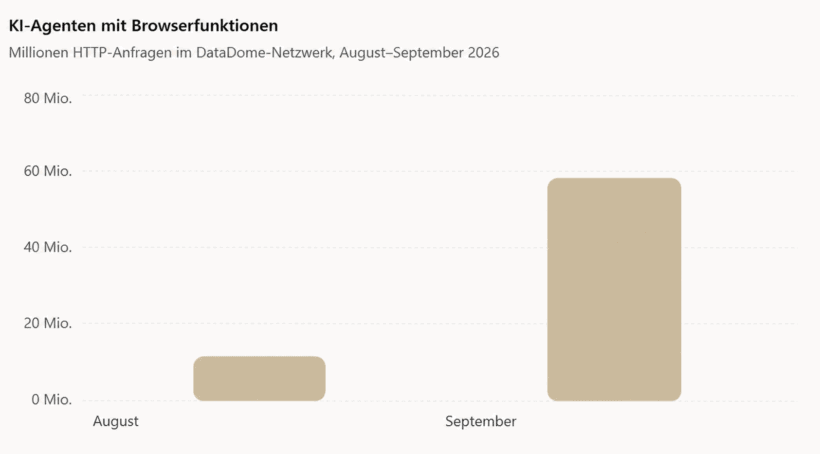
Figure: Report by HUMAN Security dated November 9, 2026 – Increase in browser sessions by AI agents. Background: AI agents are gaining more and more access and permissions. This allows them to navigate the Internet with increasing autonomy (Source: humansecurity.com)
For the Internet and the entire IT world, these changes represent a fundamental transformation. Artificial intelligence is increasingly becoming an integral part of digital systems. The new guiding principle is “AI First.”
In the future, AI will be an integral part of the Internet and information technology. In fact, this development is unfolding so rapidly that its positive and negative effects are already becoming apparent today. What we are currently witnessing is the early stages of a new generation of the Internet, whose possibilities and implications are only gradually coming into focus.
This development is still in its early stages. New technologies are being tested, and AI systems are sometimes used in a playful manner and often with too much trust. At the same time, these same technologies are also being misused for criminal purposes. Security mechanisms, binding standards, and clear rules for dealing with autonomous AI systems are still being developed in many places. A situation is emerging in which technological possibilities are growing faster than the ability of society, the economy, and the political sphere to keep pace with these changes.
The Agentic Web
We are thus at the dawn of the development of what is known as the “Agentic Web.” This refers to a new or evolving form of the Internet in which AI agents no longer merely search for and summarize information, but increasingly take on tasks independently, use services, prepare decisions, and communicate with other digital systems. The Internet is thus evolving from an environment in which people primarily visit and use websites to an infrastructure in which AI systems interact directly with one another.
This shift is fundamentally transforming the traditional website as we know it. While websites as we know them today will not disappear, their function will change significantly. For the most part, they will evolve into digital storefronts that showcase companies and organizations to the outside world, while in the background—or in parallel—an increasing portion of the actual information retrieval and use of digital services will take place via AI systems.
At the same time, other websites will evolve into comprehensive, AI-driven data and service platforms. Companies and organizations must increasingly provide information, offerings, and services in a way that is not only understandable and accessible to humans, but above all to AI agents. These agents should be able to find, correctly interpret, and make further use of offerings, services, and products as reliably as possible.
The Era of Search Engine Results Is Coming to an End
Just how profound this change is becomes particularly clear when it comes to searching the Internet. Just five to ten years ago, searching for information largely followed a uniform principle. Search engines like Google scoured the internet with automated search robots, indexed website content, and then made it available in extensive lists of search results. Anyone looking for specific information would receive numerous hits spread across several results pages. Users had to compare these results themselves, visit various websites, and gather the desired information on their own.
This principle is currently undergoing a fundamental shift. Whereas the focus used to be on providing as comprehensive a selection of search results as possible, the trend today is moving toward “less is more”—that is, providing particularly relevant answers in the context of the specific query. AI-powered services such as ChatGPT or Google’s AI mode therefore search for and process information from various sources, evaluate its relevance, and present the user with a highly condensed selection. Instead of long lists with dozens or hundreds of possible results, often only a few sources are highlighted. In some cases, only three to five related websites are displayed. For specific questions, this trend goes even further: Instead of listing various possible answers, AI systems usually formulate a single, summarized answer, occasionally supplemented by alternative perspectives or additional sources.
This is changing not only the way people search for information, but also how information is found and perceived in the first place. In the past, anyone who appeared on the first results page on Google had a good chance of attracting visitors interested in their content. In an increasingly AI-driven information landscape, a high ranking in traditional search engines alone is no longer enough. What matters most is whether a website’s information is recognized by AI systems, correctly understood, deemed trustworthy, and taken into account when answering a question. At the same time, the likelihood that users will even need to visit the original website—or visit it multiple times—is decreasing if they already receive the answer directly from an AI system.
This development has far-reaching consequences for companies and organizations. The traditional view—that a website’s primary purpose is to attract visitors and present them with information or services—is increasingly falling short. In the future, digital offerings must function even when the initial contact is made not by a human but by an AI agent. Such an agent could, for example, gather information about a service, compare different offers, check availability, prepare an inquiry, or make a reservation on behalf of a person—all without that person ever visiting the website themselves.
From Websites to Data Platforms
These developments are leading to websites increasingly transforming into structured data and service platforms. Visual design remains important, because people will continue to visit websites in the future, read and verify information on their own, and make personal decisions.
At the same time, however, a second level is emerging that is becoming increasingly important for the operation of digital services. Information, knowledge, and services must be technically formatted in such a way that AI systems can process them immediately and utilize them via appropriate interfaces. The quality, timeliness, reliability, and clear structuring of the underlying data play a decisive role in this process.
As a result, the website becomes the visible interface of a more comprehensive digital infrastructure. While the design and presentation of content have often been the focus of development in the past, the underlying data structures, their interrelationships, and their technical accessibility are becoming significantly more important. An organization’s information is no longer prepared exclusively for display on individual web pages, but rather forms a central knowledge and data foundation that can be used by the organization’s own website as well as by internal applications, external services, and AI agents.
This signals a fundamental shift in perspective. The Internet of the past decades was developed primarily to enable people to find information and interact with digital services on their own. The Internet of the coming years will increasingly be designed so that AI systems take over these tasks on behalf of people. For companies and organizations, this means they can no longer view their digital offerings exclusively from the perspective of a human website visitor. They must increasingly address the question of how their information and services will remain accessible in a world where AI agents are assuming an increasingly important intermediary role.
The transition to the Agentic Web therefore means far more than simply adding individual AI functions to existing websites. It affects the fundamental architecture of the Internet and the way in which information, services, and digital business processes will be interconnected in the future. Although this development is still in its early stages, its direction is already becoming clear. Companies and organizations that continue to develop their digital foundations accordingly today are laying the groundwork to remain visible, accessible, and capable of taking action even in an increasingly AI-driven Internet world.
Organizational knowledge is becoming central
The shift toward the Agentic Web will not only change how people use the Internet, but also how websites are technically structured. While the website itself has traditionally been the focal point of a company’s or organization’s digital presence, this focus will increasingly shift. It is no longer the website as such, but rather the underlying information, data, services, and their interrelationships that will become the true center of the digital infrastructure. The website will remain, but it will increasingly become just one of several ways to access an organization’s knowledge and digital offerings.
To understand the implications of this change, it’s worth taking a look at how many websites are structured today. In the traditional architecture, text, images, documents, events, products, and other information are managed within a content management system such as WordPress. The content is often directly linked to the website’s structure and presentation. It is assigned to specific pages, categories, or menu items and organized in such a way that people can find and read it as easily as possible. The website thus serves, in a sense, as the central repository where a large portion of an organization’s digital knowledge is stored and presented.
This form of information management has proven effective over many years. However, it is increasingly showing its limitations. Information is often entered multiple times, relationships between individual pieces of content are only partially represented, and important data is scattered across different systems. For example, information about members may be stored in separate administrative software, events may be saved in the content management system, counseling services may be described in documents, and additional information may be available in internal databases or external applications. For humans, these relationships can still be partially uncovered through navigation, search functions, and organizational knowledge. For automated systems, however, it is significantly more difficult to reliably link the information and recognize its actual meaning.
This is precisely where the architecture of a modern digital platform comes into play. Instead of organizing information primarily for display on individual web pages, an organization’s entire digital knowledge base is increasingly viewed as a standalone, structured foundation. In this context, the term “organizational knowledge” is also used. This refers to the totality of all relevant information that an organization possesses, manages, and requires for its operations. This includes not only publicly accessible texts and images, but also, for example, services, areas of responsibility, expertise, internal processes, documentation, products, offerings, and the relationships between these pieces of information.
In the future, this organizational knowledge will become far more important than any individual website. It forms the foundation upon which various digital applications can be built. The website uses this information to present it in a way that is understandable and appealing to people. A mobile app can use the same data for its own functions. Internal applications can access it to support workflows. And AI agents can use the available information to answer questions, identify connections, or perform specific services. As a result, the information does not need to be prepared and managed separately for each application; instead, it can be provided from a shared, centrally organized knowledge base.
The following figure illustrates this fundamental shift. The left side shows the previous model: A website serves as the central hub through which people access an organization’s information and services. The right side depicts the future architecture. The focus is no longer on the website, but rather on the organization’s broader knowledge base, which is connected to various applications, data sources, and services and can interact with them—for example, via AI agents or intelligent interfaces.
The website continues to play an important role, but it is no longer the sole means of accessing available information. AI agents, internal systems, and external applications are becoming additional components of this digital infrastructure.
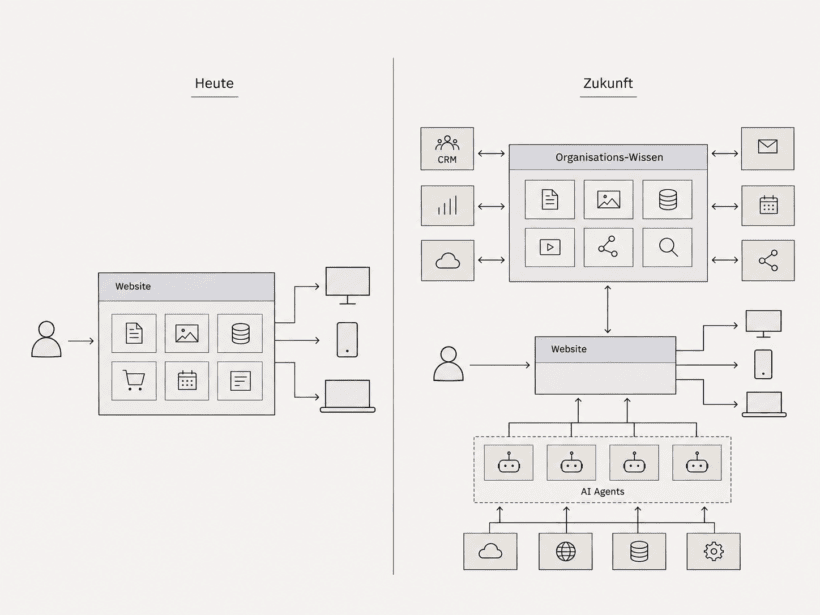
Figure: The changed architecture of a website in the “Agentic Web” (Source: rettenmund.com)
A key prerequisite for this development is that information can not only be stored but also understood in its context. This is where so-called knowledge graphs and graph databases are gaining importance. While traditional databases often organize information into tables, graph databases represent individual pieces of information as interconnected objects. These objects, also known as nodes, can represent, for example, people, companies, places, topics, services, events, or documents. Relationships are defined between them that describe how the individual pieces of information are connected to one another.
A simple example illustrates why this is important. An organization offers a consulting service that focuses on a specific subject area. There are several specialized articles, legal frameworks, events, and relevant experts related to this topic. At the same time, the consulting service may only be offered in certain regions or may be aimed at specific target groups. On a traditional website, this information is often stored on different pages or within different categories. Connections between the information must be established through links, search functions, or manual assignments.
In a knowledge graph, however, these relationships can be explicitly described. The advisory service is linked to the corresponding subject area, which in turn is linked to the relevant articles, documents, and legal foundations. The event covers the same topic, while the responsible specialist is linked to the consulting service and the corresponding regional organizational unit. This creates a network of information that captures not only the individual pieces of content but also their meaning and their relationships to one another.
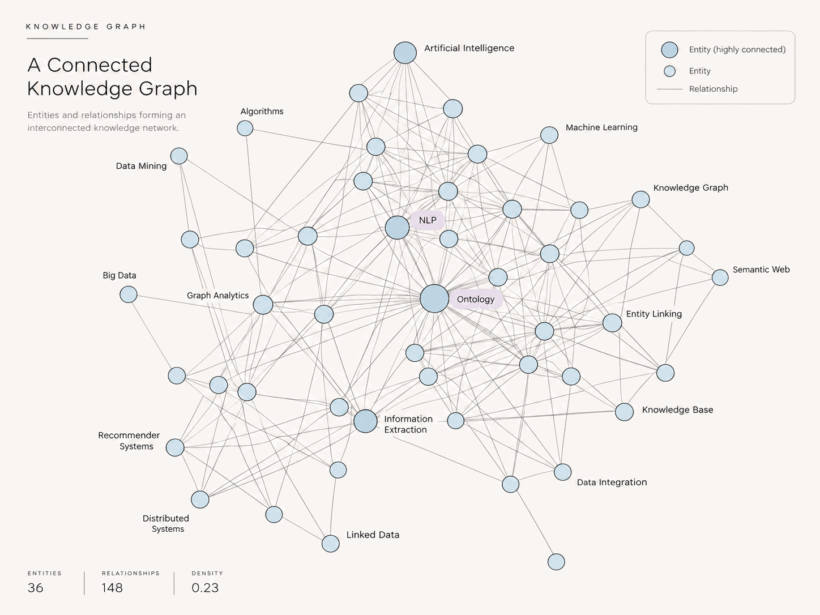
Figure: Knowledge Graph representation of a Wikipedia article (Source: cambridge-intelligence.com)
Such a structure is particularly valuable for AI systems. For example, if a user asks which counseling services are available in their region for a specific topic, the AI no longer has to rely solely on searching through numerous texts and deriving possible connections from them. Instead, it can draw on predefined relationships and specifically compile the information relevant to answering the question. This reduces reliance on pure text interpretation and creates better conditions for precise, transparent, and up-to-date answers.
However, not all information necessarily has to be stored in a graph database. Existing relational databases and modern content management systems can also represent structured relationships. Graph databases are particularly well-suited for situations where a large amount of diverse information needs to be linked through complex, overlapping relationships. What matters most, therefore, is not so much the choice of a specific database technology as the principle of treating information no longer as isolated pieces of content, but rather as components of a coherent knowledge system.
This also changes the role of the content management system (CMS), which is used to manage content online. A CMS is still needed to capture, edit, and publish content. However, it no longer necessarily has to dictate the entire digital architecture. Rather, it can become part of a higher-level platform where information is managed regardless of its subsequent use.
For example, once a technical article has been entered into the system, it could appear on the website, be available in a mobile app, be included in an internal knowledge search, and be made available to authorized AI services via a technical interface.
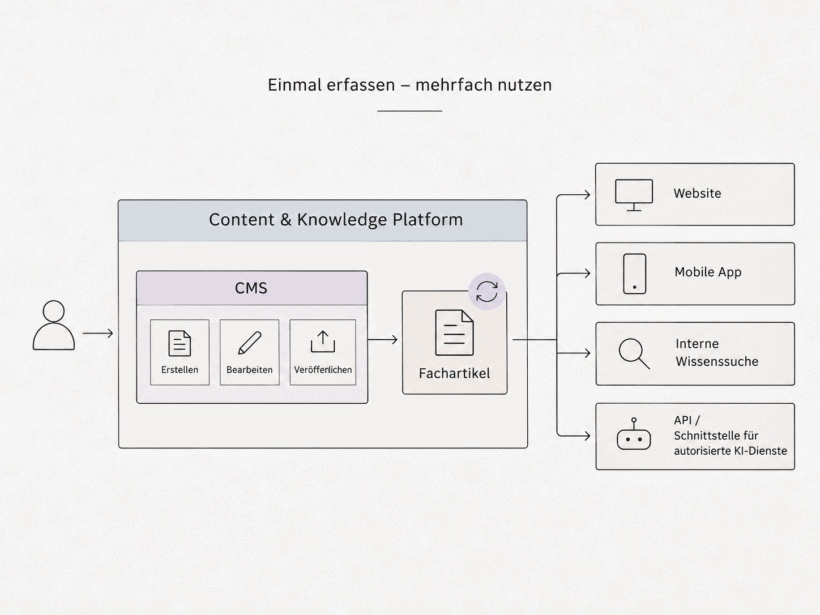
Figure: Content is managed and stored centrally in a single location, but can be simultaneously distributed to various digital channels such as websites, AI agents, and technical interfaces
Such technical interfaces, known as APIs, play a central role in this architecture. They enable different systems to exchange information in a defined and controlled manner. As a result, an AI agent does not necessarily have to visit a website and read its content like a human would. Instead, it can retrieve the necessary information directly via a suitable interface. Depending on its permissions, it can also perform certain functions, such as checking the availability of an offer, submitting a request, or triggering a defined business process.
As a result, the existing website will gradually evolve into a digital service platform. It will no longer be limited to displaying information, but will also make the underlying services and functions available to other systems. The website will then no longer be the only place where a service can be used. It will become one user interface among many, while the actual processing takes place via shared data, applications, and interfaces.
This development opens up new opportunities for companies and organizations. Information can be managed more consistently, processes can be further automated, and existing services can be offered through additional digital channels. For example, an organization no longer has to recreate all content from scratch for every new communication channel. Instead, different applications can draw on the same knowledge base and present the information in an appropriate format for each context. This also allows changes to be implemented more efficiently. For example, if a responsible specialist, a service, or a legal basis is updated, this change can be reflected in all connected applications.
However, as connectivity increases, so does the responsibility for ensuring the quality and security of information. A central knowledge base is reliable only if the data it contains is up-to-date, traceable, and correctly linked. Equally important is the clear distinction between publicly accessible information and confidential internal knowledge. Not every AI agent and not every application should be allowed to access all of an organization’s data. Therefore, clear access permissions, controlled interfaces, and transparent rules are needed to specify which information may be read or modified by which systems. Particularly in the case of automated actions, it must also be defined when a system is permitted to act independently and when human approval is required.
As a result, the technical modernization of a website is increasingly becoming an organizational task as well. Companies and organizations must ask themselves not only what their future website should look like, but above all, what information they possess, where it is stored, how it is interconnected, and who is responsible for maintaining it. It often becomes apparent that valuable knowledge already exists but is scattered across different departments, documents, and applications. Systematically capturing, structuring, and linking this knowledge can, in the long term, yield significantly greater benefits than a purely visual redesign of the website.
This approach offers significant potential, particularly for organizations with a vast amount of information, diverse departments, regional structures, and numerous services. Instead of building an ever-larger and more complex website, the existing information can be organized within a shared digital knowledge structure. From this, various offerings can be developed that are accessible to both people and AI systems. Existing websites do not necessarily have to be completely replaced for this purpose. Often, the development can take place gradually by better structuring existing data, adding relationships, and making individual functions accessible via modern interfaces.
In the long term, this will also change how the value of a digital presence is measured. Until now, the focus has often been on the number of web pages, their design, visitor numbers, and visibility in search engines. These factors will continue to play a role, but they are no longer sufficient on their own to assess an organization’s digital performance. It will become increasingly crucial how well an organization manages its knowledge, how reliably its information is interconnected, and how easily its services can be accessed across various digital channels.
The true value of a future digital platform therefore lies less and less in its visible interface alone, and increasingly in the quality and usability of the underlying information and service infrastructure. A well-designed website remains an important showcase and a central point of access for people. However, the organization’s knowledge is evolving into a lasting foundation upon which the website, internal applications, and AI-powered services can collectively build.
The website of the future is no longer the center of an organization’s digital knowledge, but rather one of several showcases through which this knowledge becomes accessible and usable. The better the information is structured, interconnected, and technically accessible behind the scenes, the less dependent the organization becomes on individual websites, platforms, and technologies. This is precisely one of the essential prerequisites for further developing digital offerings over the long term and preparing them for the demands of the emerging Agentic Web.
It’s better to start these preparations sooner rather than later. Companies and organizations that adapt their digital offerings to these changes early on can gain a significant competitive edge. Those who wait too long, on the other hand, risk seeing other providers become better positioned and receive preferential treatment from AI systems—precisely because services like ChatGPT or Google are increasingly presenting only a few select sources of information and recommendations.