Most companies and organizations have invested a great deal of time and money in their websites in recent years. They have described their services, cataloged their products, published their expertise, and compiled information for customers, members, or business partners. With every new page, a portion of the company’s knowledge or expertise has made its way onto the Internet. While the design and technical capabilities of websites have continually evolved, one fundamental principle has largely remained the same: information is primarily prepared for display on individual web pages. Nothing more.

With the increasing use of artificial intelligence and the interconnection of digital services, this starting point is changing. In the future, corporate knowledge will not only be read by people, but increasingly processed by applications, exchanged between systems, and utilized by intelligent assistants. This raises a question that will be crucial for the long-term development of a company’s digital presence: Why should valuable information be limited to functioning exclusively within a single website?
The Website as a Repository for Corporate Knowledge
A typical corporate website consists of a large number of pages containing text, images, documents, and forms. Anyone looking for a service visits the relevant subpage, reads the description, and contacts the company if interested. On an association’s website, members can find information about events, advisory services, and publications. A tourism portal showcases accommodations, attractions, regions, and activities. This information has often been compiled over many years and, taken together, forms a substantial body of knowledge. In everyday practice, however, a distinction is rarely made between the company’s actual knowledge and its presentation on a website. The two are closely intertwined, so that some information can only be maintained and used in the context of the respective website.
At first glance, this integration seems obvious, but it has long-term drawbacks. For example, information about a service may appear simultaneously on the website, in a brochure, on a customer portal, and in an internal document. If prices, hours of operation, or areas of responsibility change, multiple locations may need to be updated. The larger an organization becomes and the more digital applications it uses, the more difficult it becomes to keep all information up-to-date and consistent. The problem does not necessarily lie in the technology used, but often in the lack of separation between the knowledge itself and the various locations where that knowledge is published.
It has long been scientifically established that data quality encompasses far more than the mere accuracy of a piece of information. As early as 1996, Richard Wang and Diane Strong demonstrated in a widely acclaimed study that, from the users’ perspective, information must not only be accurate but also understandable, relevant, accessible, and suitable for its intended purpose. Subsequent work on data management has addressed the question of how organizations can define responsibilities, quality standards, and decision-making authority regarding their information. [1, 2] These findings are particularly relevant today because digital information is increasingly no longer interpreted exclusively by humans. Whereas in the past an unclear description could be clarified through a follow-up phone call, automated systems require unambiguous information and clear contextual relationships.
Added to this is a shift in usage patterns. According to a survey by the Federal Statistical Office, by the spring of 2025, 43 percent of the Swiss population between the ages of 15 and 88 had already used generative AI at least once. This figure does not yet indicate how many people use AI to make specific purchasing decisions or have their tasks handled by autonomous agents. However, it does show how quickly an additional form of information use is becoming established. [8] People no longer necessarily have to search for information themselves on various websites; instead, they can have connections explained to them, compare offers, or have extensive documents summarized. For companies, this means that their information should be available and understandable in a variety of usage scenarios in the future, even though their own website will remain an important point of access.
Individual pieces of content are combined into a cohesive information system
The key step is to stop viewing company information solely as components of individual web pages and instead view it as independent, interconnected pieces of information. An event, for example, is not simply a text with a date and an image, but a clearly defined offering with an organizer, a location, a time, a target audience, and possibly a registration option. A service has specific characteristics, is available at one or more locations, and is offered by a clearly identified organization. This information can still be displayed on a website. However, it can also be used for other applications without having to be re-entered or extracted from existing webpage text.
The example of a Swiss tourism portal illustrates just how significant this difference is. A traditional website guides visitors through countries, regions, towns, and individual offerings to the information they’re looking for. This works well for people who want to navigate through the site and compare offerings. However, if the same set of information is structured as a cohesive data model, the relationships between these pieces of information can be utilized independently of the navigation. A hotel is located in a specific town, belongs to a tourist region, has certain amenities, and is situated near various attractions. A golf course can be associated with multiple hotels, an event takes place at a specific location, and a tourist destination is accessible during a specific season. These relationships open up possibilities for search functions, trip planners, personalized offers, and—in the future—AI assistants designed to combine multiple criteria.
The foundations for this predate the current development of generative AI. As early as 2009, Christian Bizer, Tom Heath, and Tim Berners-Lee described, through the concept of *Linked Data*, how information on the Internet can be published not only as documents but also linked together using unique identifiers and defined relationships. [3] Research on so-called *knowledge graphs* has further developed this approach. Such knowledge graphs describe not only individual pieces of information but also their interrelationships, thereby enabling a more nuanced use of extensive bodies of knowledge. The scientific work of Natasha Noy and her co-authors, as well as that of Aidan Hogan and his research team, shows that such concepts have long been in use in large information systems. [4, 5] For a smaller organization, however, this does not mean that it must operate its own graph database. What is crucial, first and foremost, is that information is clearly distinguishable, has persistent identifiers, and can be meaningfully related to one another.
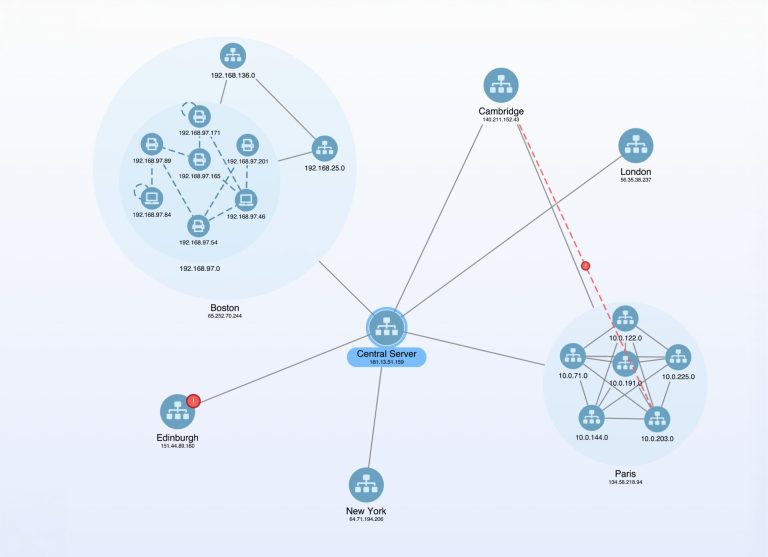
Figure: Graph (Source: Cambridge Intelligence)
Another important principle stems from scientific data management. The FAIR principles, published in 2016, state that data should be findable, accessible, interoperable, and reusable. What makes these principles unique is that they explicitly take machine processing into account. [6] Applied to the business world, this means that information should be organized in such a way that different applications can use it reliably. Accessibility should not be equated with unrestricted publication. A company can describe its public services in a freely accessible manner while simultaneously protecting internal business data, member information, or personal details. What matters is the controlled usability of the data, not its complete disclosure.
In practice, this results in what can be described as a central information repository. This does not require all data to be physically stored in a single database. Larger companies, in particular, already have specialized systems for products, customers, members, bookings, or events. A well-designed architecture can link these existing data sources and make them accessible via clearly defined interfaces. It is important that, for each piece of information, it is clearly established which system is the authoritative source, who is responsible for maintaining it, and how other applications are permitted to access it. International recommendations from the World Wide Web Consortium, including the “Data on the Web Best Practices” published in 2017, address precisely these requirements regarding metadata, persistent identifiers, data quality, reusability, and interfaces. [9]
One of several possible interfaces: The website of the near future
,
. A key consequence of this development concerns the structure of websites themselves. While content and its presentation are often closely linked in traditional systems, both areas can increasingly be organized independently of one another from a technical standpoint. The website’s primary role is then to present information to users in a clear, understandable, and appealing way. Behind the scenes lies a separate layer where content, data, and—where applicable—business processes are managed. The same information can also be made available via appropriate interfaces to a mobile app, a member portal, an external partner, or a company’s own AI assistant.
In technical circles, this type of separation is often referred to as a *headless* or *decoupled* architecture. For management, however, it is not so much the term itself but rather the business benefits that matter. A company can revamp its public website, offer new digital services, or tap into additional communication channels without necessarily having to replace its entire information infrastructure. For example, a Swiss association could centrally manage its professional publications, events, and consulting services while simultaneously making them available on its public website, in a restricted members-only area, and in an internal knowledge search. A multilingual organization could manage content and its translations collectively, while different user interfaces access the same information. This does not make the website any less important, but rather makes it more independent of the technical management of the content.
This separation can already be implemented today using established systems. With its REST interface, WordPress provides ways to use content in other applications, while Drupal, with its data modeling and the JSON:API, offers extensive functionality for the structured delivery of information. [12, 13] However, this does not mean that every corporate website should be built entirely as a decoupled system in the future. For many smaller businesses and organizations, a well-maintained, traditional content management system may still be the most cost-effective solution. The crucial question is rather whether the solution used can scale with the requirements and whether valuable information remains preserved and usable even if the visible website or individual technical components change.
The growing importance of artificial intelligence reinforces this idea. In what is known as *Retrieval-Augmented Generation* (RAG), language models draw on additional information sources when answering questions. This method was the subject of a scientific study in 2020 by Patrick Lewis and his co-authors, among others. [7] For companies, it opens up the possibility of using their own knowledge bases as the foundation for AI-powered information systems. For example, an organization could offer an assistant that answers questions about its services, regulations, or publications and cites the sources used. This requires not only suitable technical interfaces but, above all, up-to-date, well-structured, and reliable information. AI can assist in searching for and processing knowledge; however, it neither replaces professional responsibility for the content nor eliminates the need to regularly verify its accuracy.
It would also be incorrect to conclude from this trend that structured business data automatically leads to better rankings in AI-generated search results. Google explicitly states in its official recommendations that no special additional markup is required for inclusion in its AI search functions and that the existing principles of good search engine optimization still apply. [10] Structured data—for example, based on Schema.org—helps to unambiguously describe information about companies, products, services, or events and supports certain functions of search engines and other applications. [11] However, it is only one component of a broader information architecture. A machine-readable description does not, in and of itself, turn an incomplete or outdated information repository into a reliable data source.
What Your Company Should Do With Its Digital Information
For Swiss SMEs, associations, clubs, and foundations, this transformation therefore does not necessarily begin with a new website or a major technical investment. Rather, it is worthwhile to first view the existing information as a cohesive corporate asset. What content is particularly important to customers, members, or other stakeholders? Where is this information currently collected and maintained? Which data points exist in multiple places, what relationships exist between them, and what information could also be used outside the website in the future? Even a careful inventory can reveal where information is managed in duplicate, where updates are unnecessarily time-consuming, or where valuable expertise remains hidden in individual documents.
A sensible next step is to clearly structure particularly important information and establish a mandatory process for maintaining it. For an association, this might include member benefits, events, locations, and publications; for an SME, it might include services, products, experts, or references. Larger portals also often require a detailed description of their offerings and the relationships between different pieces of information. However, not everything needs to be implemented at once. It is often more economically sensible to start with the data sets that are already being used in multiple ways or that require a significant amount of maintenance. Only then can a well-informed decision be made as to whether additional interfaces, an expanded data model, or a more decoupled system architecture offer actual added value.
Equally important is the question of which information may be made publicly available and which must remain protected. The Swiss Data Protection Act requires appropriate technical and organizational measures when processing personal data and explicitly takes into account data protection through design and privacy-friendly default settings. [14] A future-proof digital information architecture must therefore not simply publish as much data as possible, but rather be able to control its use in a targeted manner. Public corporate information, internal documents, and personal data require different access permissions and protection mechanisms. This distinction will become increasingly important, especially as more applications and intelligent agents access corporate systems in the future.
Ultimately, the real benefit of this development lies in a shift in how we view digital investments. A website will continue to fulfill an important role in the future: it conveys a first impression, builds trust, showcases services, and enables direct contact with an organization. Its design, user-friendliness, and technical quality therefore remain essential. However, if the knowledge behind the website is organized independently of its presentation, new requirements can be met with much greater flexibility. The company does not have to start from scratch with every technological change but can build upon an existing information foundation that can be further developed in a targeted manner.
**The website of the future is therefore not simply a more modern version of today’s website. It is increasingly the visible interface of a digital information foundation that extends far beyond the individual website.** For companies, this presents an opportunity not only to present their existing information more effectively, but also to make more meaningful use of it over the long term. The most important step is to stop viewing corporate knowledge exclusively as the content of individual web pages, but rather as an independent asset that can be maintained, linked, and made accessible for various applications, regardless of how it is presented.
—
*This post is part of our article series“Websites in Transition,”in which we explore how artificial intelligence is changing the requirements for corporate websites and which developments will be relevant for businesses and organizations.*
Sources and Further Reading
**Scholarly Publications**
1. Wang, R. Y. & Strong, D. M. (1996). *Beyond Accuracy: What Data Quality Means to Data Consumers*. Journal of Management Information Systems, 12(4), 5–33. [Academic publication](https://www.jmis-web.org/articles/1002)
2. Khatri, V. & Brown, C. V. (2010). *Designing Data Governance*. Communications of the ACM, 53(1), 148–152. https://doi.org/10.1145/1629175.1629210
3. Bizer, C., Heath, T., & Berners-Lee, T. (2009). *Linked Data – The Story So Far*. International Journal on Semantic Web and Information Systems, 5(3), 1–22. https://doi.org/10.4018/jswis.2009081901
4. Noy, N. et al. (2019). *Industry-scale Knowledge Graphs: Lessons and Challenges*. Communications of the ACM, 62(8), 36–43. [Google Research](https://research.google/pubs/industry-scale-knowledge-graphs-lessons-and-challenges/)
5. Hogan, A. et al. (2021). *Knowledge Graphs*. ACM Computing Surveys, 54(4), Article 71. https://doi.org/10.1145/3447772
6. Wilkinson, M. D. et al. (2016). *The FAIR Guiding Principles for Scientific Data Management and Stewardship*. Scientific Data, 3, 160018. https://doi.org/10.1038/sdata.2016.18
7. Lewis, P. et al. (2020). *Retrieval-Augmented Generation for Knowledge-Intensive NLP Tasks*. Advances in Neural Information Processing Systems, 33. [NeurIPS Proceedings](https://proceedings.neurips.cc/paper/2020/hash/6b493230-Abstract.html) **Public Institutions, Standards, and Technical Practice Sources**
8. Federal Statistical Office (2025). *Internet Use in Swiss Households 2025*. Press release dated December 5, 2025. [Federal Statistical Office](https://statistik.admin.ch/de/asset/36304417)
9. World Wide Web Consortium (2017). *Data on the Web Best Practices*. W3C Recommendation. https://www.w3.org/TR/dwbp/
10. Google Search Central (2026). *AI Features and Your Website*. Official documentation on AI features in Google Search. [Google Developers](https://developers.google.com/search/docs/appearance/ai-features)
11. Schema.org. *Schemas for Structured Data on the Internet*. https://schema.org/
12. WordPress.org. *REST API Handbook*. https://developer.wordpress.org/rest-api/
13. Drupal.org. *JSON:API Module – API Overview*. [Drupal Documentation](https://www.drupal.org/docs/core-modules-and-themes/core-modules/jsonapi-module/api-overview)
14. Swiss Confederation. *Federal Act on Data Protection (DSG)*, in particular Articles 7 and 8. [Fedlex](https://www.fedlex.admin.ch/eli/cc/2022/491/de)