In an increasingly digitalized world, the responsibility of designers and developers is becoming ever greater. **Ethical design** and inclusive design** are no longer optional extras, but fundamental requirements for modern web applications. Ethical design focuses on the transparency and well-being of the user, while inclusive design ensures that digital products can be used by people with a wide range of abilities, backgrounds and neurological differences. In 2025, this approach is not just a moral obligation, but a clear **business case** that massively increases the reach, brand loyalty and innovative power of companies.
Ethical design: the red line against manipulation
Ethical design is the practice of designing digital products in a way that respects the autonomy and well-being of users. It is the direct counter-movement to manipulative tactics that aim to persuade users to take actions that are not in their best interests.
Dark Patterns: The ethical red line
Dark patterns** are design tricks that deceive or manipulate users in order to persuade them to take a certain action (e.g. take out a subscription or disclose more data). Examples include hidden costs, misleading buttons or making it more difficult to cancel services. Ethical design requires **complete transparency** and compliance with the W3C Ethical Web Principles [1].
| Principle | Ethical design | Manipulative design (dark pattern) |
|---|---|---|
| Transparency | Clear, simple language and processes. | Hidden information, preset options. |
| Data protection | Privacy by design, data minimization. | Forcing consent, more difficult opt-outs. |
| Action | Simple termination or deletion of accounts. | “Roach Motel” (easy in, hard out). |
Inclusive design: expanding the user group
Inclusive design goes beyond pure accessibility (WCAG compliance). It considers the full range of human differences – in terms of ability, language, culture, gender and neurological diversity.
The business case for inclusion
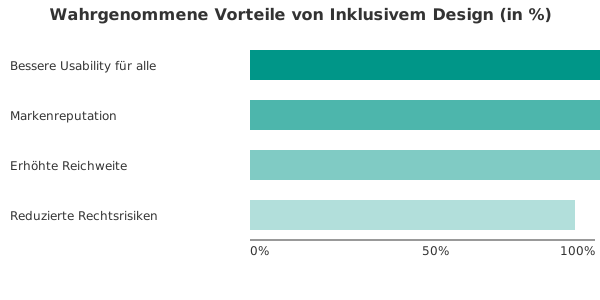
Ignoring inclusion is a massive loss of market potential. An estimated **1.3 billion people** worldwide have some form of disability [2]. Studies show that **72% of disabled consumers** abandon purchases due to barriers [3]. Inclusive design is therefore a clear competitive advantage:
- Increased reach: opening up new customer segments.
- Improved SEO: Accessible websites are often technically cleaner and are rated better by search engines.
- Brand loyalty: Companies that take inclusion seriously build a stronger bond with their customers.
*Source: Adapted from Level Access and Forrester [3] [4].
Neurodiversity: The next frontier of UX
An emerging trend in inclusive design is the consideration of **neurodiversity**. It is estimated that around 15-20% of the population is neurodivergent (e.g. autism, ADHD, dyslexia) [5]. These users process information, navigate and interact with digital interfaces in different ways.
Design principles for neuro-inclusion
Designing for neurodiversity requires specific adaptations that reduce the cognitive load:
- Reduction of cognitive load: Clear, consistent layouts, avoidance of unnecessary animations or flashing elements.
- Flexibility and control: Allow users to customize the display (e.g. font size, line spacing, color schemes).
- Clear language: avoid jargon and complex sentence structures.
- Explicit feedback: Clear confirmation of actions to avoid uncertainty [6].
| Neuro-difference | The challenge | Inclusive design solution |
|---|---|---|
| ADHD | Distraction from excessive animations or notifications. | Possibility to pause or deactivate animations; focus modes. |
| Dyslexia | Difficulty reading blocks of text. | Customizable fonts, high contrast, short line lengths. |
| Autism | Overwhelmed by unpredictable interactions. | Consistent navigation, clear expectations of interactions. |
The responsibility of the digital age
Ethical and inclusive design are the pillars of digital responsibility in 2025, shifting the focus from pure functionality to the **human impact** of our digital products.
Companies that integrate these principles into their design and development process from the outset not only build better web applications, but also future-proof and ethical ones. The future of the web is one that is accessible, transparent and respectful for all. It’s time we see the web not just as a technology, but as a **social infrastructure** and design it accordingly.
List of sources
- W3C. (2024). Ethical Web Principles: Building a better web. [Online article]
- WHO. (n.d.).
Disability and Health . (Referenced in [3]) - Level Access. (2025). The Business Case for Digital Accessibility. [Online article]
- Forrester. (2023). Inclusive Design: Three Steps To Build A Business Case. [Online article.]
- Print Magazine. (2025). Designing for the 15%: Why Neurodivergent UX Is the Future. [Online article]
- UX Planet. (2025). UX Trend 2026 #4: Designing for Neurodiversity & Inclusion. [Medium article]
- Future Processing. (2025). Ethical design: principles, benefits and examples. [Online article]